


My Adjustable Bed Stopped Working: Try These Fixes First
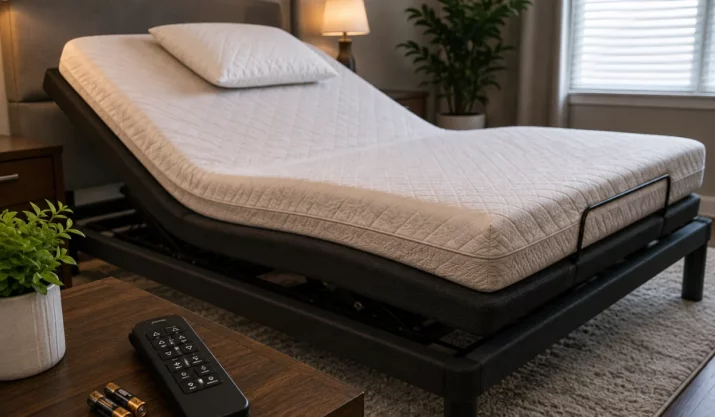
Table of Contents
You press the remote, but the bed does not move. The head section may be stuck upright, one side may respond while the other stays flat, or the remote may light up without controlling anything. When my adjustable bed stopped working, the cause could be as simple as weak batteries or a loose power plug.
Start with the checks that do not require tools or electrical work. Adjustable bases contain heavy moving parts, motors, wiring, and control units. A careful inspection can solve common problems, but opening a motor or control box should be left to the manufacturer or a qualified repair technician.
Check for Safety Problems Before Troubleshooting
Unplug the adjustable base before reaching beneath the frame or touching any cables. Keep your hands away from hinges, lifting arms, and other moving joints, even when the bed appears to have no power. A raised section can shift if a blocked mechanism releases.
Stop using the base if you notice smoke, sparks, damaged insulation, melted plastic, repeated breaker trips, or a burning smell. These signs call for professional service rather than another reset attempt.
| What You Notice | What You Should Do |
|---|---|
| Burning smell, smoke, or sparks | Unplug the base and stop using all powered functions |
| Melted plug or discolored outlet | Do not reconnect the bed until the outlet and base have been checked |
| Exposed, cut, or crushed wiring | Replace the correct cable or contact the manufacturer |
| Breaker trips more than once | Leave the base unplugged and contact an electrician or service technician |
| Bent frame or grinding metal | Stop operating the base to prevent more damage |
| Bed moves without a command | Remove the remote batteries, unplug the base, and request service |
An adjustable bed problem can also disrupt an established sleep routine. The Centers for Disease Control and Prevention (CDC)’s sleep report found that 30.5% of U.S. adults averaged fewer than seven hours of sleep in a 24-hour period. The rate reached 34.5% among adults ages 50 to 64.
| Sleep Measure | Percentage |
|---|---|
| All adults sleeping fewer than seven hours | 30.5% |
| Adults ages 18 to 34 | 27.2% |
| Adults ages 50 to 64 | 34.5% |
| Adults age 65 and older | 27.2% |
These numbers do not prove that an adjustable bed improves sleep. They show why a base stuck in an uncomfortable position can create a serious problem for someone who already struggles to rest.
Identify What the Adjustable Bed Is Doing
The exact symptom can narrow the list of possible causes. Press one button at a time and listen for a motor, relay click, or warning tone. Note whether the remote lights up, the massage feature works, or one part of the frame still moves.
Do not press several buttons in rapid succession. Testing each function separately makes it easier to tell whether the problem affects the entire base, one motor, or the remote.
| Symptom | First Things to Check | Possible Next Issue |
|---|---|---|
| No sound, light, or movement | Outlet, breaker, plug, power supply | Failed power supply or control box |
| Remote lights up, but nothing moves | Child lock, pairing, remote batteries | Receiver or control-box fault |
| Motor hums, but the frame does not move | Obstruction, bedding, excess weight | Binding actuator or damaged linkage |
| Head moves, but foot section does not | Foot motor cable and connector | Foot actuator failure |
| Foot moves, but head section does not | Head motor cable and connector | Head actuator failure |
| One split base moves and the other does not | Power to both bases, sync cable, remote setup | Lost pairing or failed controller |
| Massage works, but the base does not lift | Lift motor cables and control connections | Actuator or control output fault |
| Base stops after several adjustments | Motor temperature and usage limit | Overload or failing motor |
The entries in this table are diagnostic clues. They are not confirmed repair findings. Different faults can produce similar symptoms.
Try These Adjustable Bed Fixes in Order
Work from the simplest check to the more involved ones. This order reduces unnecessary part replacement and helps you identify which step restores operation.
1. Test the Outlet and Circuit
Plug a working lamp or another small device into the wall outlet. If it has no power, check the circuit breaker and any nearby safety outlets with “Test” and “Reset” buttons. One of these outlets may control power to the bedroom receptacle.
Reset a tripped breaker or safety outlet once. If the power cuts out again, there may be an electrical fault in the bed, outlet, or household wiring. Do not keep resetting it.
Confirm that the adjustable bed’s plug sits fully inside the outlet. Bed movement, cleaning equipment, pets, or objects stored near the wall can pull the plug partway out.
2. Inspect the Power Supply and Visible Connections
Unplug the bed, then follow the power cord from the outlet toward the frame. Many adjustable bases use a power brick connected to a separate cable that runs to the control box. Press each accessible connector into its matching socket.
Look for crushed wire, loose plugs, bent pins, dark marks, pet damage, or a cable caught between moving sections. Do not repair exposed wiring with household tape. Order the correct replacement part for the base model.
Some power bricks and control boxes have indicator lights. A dark light may mean that power is not reaching the component. A lit indicator confirms incoming power, but it does not prove that the motors or remote receiver work.
3. Replace the Remote Batteries
Install a fresh matching set of batteries. Check the positive and negative markings, then close the battery cover before testing the remote. Mixing old and new batteries can produce weak or inconsistent operation.
A remote light can still come on when its batteries are too weak to send a dependable signal. Test the head, foot, flat, and massage functions after installing the new set. One failed button may point to damage inside the remote, while every button failing may suggest a lock, pairing, or receiver problem.
4. Check the Child Lock
Many adjustable bed remotes include a child-lock or control-lock setting. When this feature is active, the bed may appear to be broken even though the power system works.
Look for a padlock symbol, blinking light, or warning on the remote screen. Unlocking instructions differ between models. Some require two buttons to be held together, while others use a switch or a timed sequence.
Use the manual written for your exact adjustable base and remote. Manufacturer instructions often begin with the outlet, remote batteries, and control-lock setting, but the correct reset and pairing steps depend on the model.
5. Power-Cycle the Base
Unplug the adjustable bed and leave it disconnected for the time stated in the owner’s manual. Reconnect the power, allow the control box to start, then test one movement button.
A power cycle may clear a temporary communication error after an outage or interrupted command. It is not always the same as a factory reset. A full reset can remove saved positions or pairing information, so follow the model instructions before using one.
6. Pair the Remote Again
A remote can lose its connection after a power failure, battery change, control-box replacement, or reset. Pairing often involves a button on the control box or power cable and a second button on the remote.
Do not copy a pairing sequence from an unrelated brand or model. The wrong sequence may activate a lock, memory setting, or sync mode. Find the base model, remote number, and manufacturer instructions before starting.
Check for Obstructions and Motor Problems
A powered base needs clear space around its moving sections. Unplug the unit and inspect beneath the frame with a flashlight. Storage containers, shoes, blankets, cords, pet toys, and mattress fabric can block the lifting mechanism.
Check whether the base touches a wall, headboard, nightstand, or surrounding bed frame. A mattress that has shifted can also press against furniture and limit travel. Keep your fingers out of joints and never crawl beneath an unsupported raised section.
Remove Excess Weight
Every adjustable base has a stated weight limit. The total can include the mattress, sleepers, bedding, and anything placed on top of the bed. Too much weight may slow movement, trigger a protection system, or stop a motor from lifting.
Remove people and heavy objects before testing the base again. Do not use the bed to lift boxes or furniture unless the manual says the model can carry those items.
Let the Motors Cool
Adjustable bed motors usually run for short periods. Repeatedly raising and lowering the frame can activate a temperature or duty-cycle limit. The bed may stop responding until the motor has cooled.
Follow the rest period in the owner’s manual. Do not place ice, water, or wet fabric near the motor. If the base shuts down during ordinary use, a motor may be overloaded, binding, or starting to fail.
Listen for Humming, Clicking, or Grinding
A humming motor may be receiving power while an obstruction or damaged mechanism prevents movement. A clicking control box may point to a loose connection, failed actuator, or electrical output problem.
Unplug the bed before checking visible motor plugs. Stop testing if the frame jerks, twists, or makes a grinding sound. Continued operation can bend linkage parts or place added strain on the motor.
Lower a Bed That Is Stuck Upright
Do not push the head or foot section down by hand. The actuators and lifting arms are not designed to be forced backward. Pushing on the frame may damage a motor, bend a bracket, or cause the raised section to drop.
Check the owner’s manual for an emergency-lowering procedure. Some bases use a battery backup strap or compartment. Others have a lowering button on the control unit or a remote sequence made for power outages.
Fresh batteries may be needed for the emergency function, and the feature may lower the bed only once. Follow the instructions for your exact model. Do not assume another manufacturer’s method will work.
Adjustable bases are heavy and awkward to turn over. Do not flip the unit alone. If the mattress must be removed to reach a backup system, ask another adult for help and keep children and pets away from the frame.
Know When to Stop and Request Repair
Contact the manufacturer, retailer, or an adjustable-base repair technician if the bed still does not respond after the basic checks. Stop using the base if you notice damaged wiring, repeated breaker trips, grinding, uneven movement, heat, smoke, or melting.
Before calling, collect the brand, model number, serial number, remote number, and proof of purchase. Check the warranty before opening any electrical housing or ordering replacement parts. A remote or motor must match the exact base model.
The U.S. Consumer Product Safety Commission has recalled adjustable bases in the past because of fire risk. That recall applies only to the listed products, but any sign of overheating or electrical damage should be taken seriously.
When Bedroom Mobility Becomes a Larger Concern
An adjustable bed can help with comfort, but it may not solve every mobility problem at home. If getting in and out of bed, reaching another floor, or moving through the home has become difficult, it may be time to look at a wider mobility solution.
California Mobility helps homeowners compare stairlifts, home llifts, and other products that support safer movement at home. Speak with our team about your space, mobility needs, and the options that may fit your home.