

The Smart Rollator Brings Brakes Lights and Sensors Into One Frame
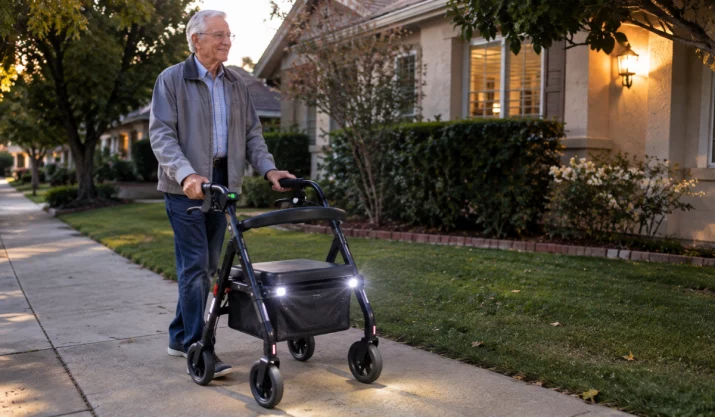
Table of Contents
- What Is a Smart Rollator?
- Smart Rollator vs. Traditional Rollator: What's the Difference?
- Who Benefits Most From a Smart Rollator?
- How Much Does a Smart Rollator Cost, and Is It Worth It?
- What to Ask Before Choosing a Smart Rollator
- Choosing Mobility Support for Greater Independence
- Frequently Asked Questions About Smart Rollators
A smart rollator combines the walking support of a traditional rollator with electronic features such as assisted braking, built-in lights, and movement sensors. Some advanced models also offer fall detection, navigation assistance, and step tracking to help users and caregivers monitor everyday mobility.
Consider a scenario where you’re walking down a sloped driveway or through a dim hallway when gripping the brakes or spotting obstacles takes extra effort. For older adults who want to remain active, a smart rollator may offer useful assistance in these situations, although features vary by model. Understanding how the technology works, what it costs, and how it compares with a standard rollator can help you decide whether it’s worth considering.
Key Takeaways
- Smart rollators combine walking support with electronic features. Depending on the device, sensors, lighting, automatic braking, and activity tracking may assist with everyday movement, but not every model includes these functions.
- The best choice depends on your mobility needs. Smart walkers may offer benefits for certain users, while traditional rollators remain practical options for people who prefer simpler controls and equipment without charging requirements.
- Cost, training, and reliability matter as much as technology. Before purchasing, ask about battery life, brake operation, weight capacity, maintenance, and whether the electronic features work as advertised under your usual walking conditions.
What Is a Smart Rollator?
A smart rollator is a wheeled mobility aid equipped with electronic components that add functions beyond traditional walking support. Like a conventional rollator walker, it has a frame, handles, and wheels designed to provide support during movement. Sensors, electronic controls, or connected technology may help monitor walking activity or provide assistance in certain situations.
The term smart walker also appears in research and product descriptions, although it can refer to a broader range of devices, including robotic walking aids. Some technologies are available in commercial equipment, while others remain experimental. Understanding this difference helps you avoid assuming that every advertised feature is included in a particular product.
Automatic Braking and Built-In Lighting
Most traditional rollators use hand-operated brakes. You squeeze the levers to slow the wheels and engage parking brakes when stopping or sitting. These controls work well for many users, but they require sufficient grip strength and coordination.
Some advanced walking aids incorporate automatic braking or electronically assisted speed control. Depending on the system, braking may respond to movement, speed, or particular operating conditions. However, automatic braking doesn’t necessarily mean a device can safely control every downhill movement or stop before an obstacle.
Integrated LED lights serve another purpose by improving visibility around the device. They may help illuminate a dim hallway or make the walker easier to notice outdoors during low-light conditions. Adequate lighting and careful movement are still necessary.
Fall Detection and Caregiver Alerts
Certain smart walking systems use motion sensors to monitor changes in movement. Some are designed to detect patterns associated with a possible fall and send an alert through a connected application or communication system.
Fall detection shouldn’t be confused with fall prevention. A device may recognize certain events without being able to stop them, and its accuracy depends on the technology and operating conditions.
If caregiver alerts are important to your family, ask whether the system requires a smartphone, internet connection, or subscription. Also confirm what information is shared, who receives notifications, and what happens when a connection is unavailable.
Navigation Assistance and Step Tracking
Some intelligent walkers use sensors to identify nearby obstacles or provide navigational guidance. The type of assistance differs between devices. Detecting an object ahead, giving directional prompts, and steering around an obstacle are separate capabilities.
Step tracking is another feature found in certain smart mobility systems. It can record walking activity and help users follow changes in their routines over time.
For someone recovering from an illness or working toward an activity goal, this information may be useful when reviewed with a healthcare professional. However, step counts and movement data aren’t substitutes for a clinical assessment of balance or walking ability.
Smart Rollator vs. Traditional Rollator: What’s the Difference?
A traditional rollator provides walking stability through a wheeled frame, adjustable handles, and manually operated brakes. Many models include a seat, storage pouch, or basket. Their straightforward design appeals to people who want dependable mobility assistance without electronic settings or charging.
A smart rollator adds technology that may assist with selected tasks or provide information about movement. These additions can be useful, but they may also increase equipment weight, maintenance needs, and the number of controls a person must learn.
Comparing Features and Everyday Use
| Feature | Traditional Rollator | Smart Rollator |
| Walking support | Yes | Yes |
| Manual brakes | Common | Depends on design |
| Automatic braking | Generally not included | Available in selected advanced systems |
| Built-in lighting | Usually requires an accessory | Included on some models |
| Fall detection | Generally not included | Available in certain systems |
| Navigation assistance | Not typically included | Available in selected intelligent walkers |
| Step tracking | Requires a separate device | Integrated into some systems |
| Battery charging | Generally unnecessary | Required for powered features |
| Maintenance | Mainly mechanical | May include electronic servicing |
*The comparison reflects broad equipment categories rather than a specific manufacturer’s specifications.
Why Fit Still Matters More Than Features
Electronic assistance can’t compensate for a poorly fitted walker. Handle height, wheel size, turning radius, and weight capacity still determine how comfortably someone can use the equipment.
A person who needs a compact walker for short trips around the house may prefer a conventional model. Someone who regularly walks outdoors may value certain electronic functions, provided the device meets their physical needs.
Before selecting either type, try the rollator on surfaces similar to those you use every day. A smooth showroom floor won’t tell you everything about handling the walker near door thresholds, driveway slopes, or uneven pavement.
Who Benefits Most From a Smart Rollator?
Smart rollators may appeal to older adults who already use walking aids and want electronic assistance for specific activities. Someone who walks frequently through neighborhood paths or parking areas, for example, may appreciate lighting or movement-monitoring features.
Connected systems can also interest families who want information about a relative’s activity. Some devices can share movement data or alerts, depending on their settings and communication capabilities. The person using the walker should understand what information is collected and be comfortable with how it’s shared.
Mobility Challenges and Fall Prevention
Falls are a serious concern for many older adults. According to the Centers for Disease Control and Prevention (CDC), more than one in four Americans aged 65 and older reports falling each year.
While this statistic doesn’t establish that smart rollators prevent falls more effectively than standard equipment, it explains why mobility support deserves attention. Electronic features should be assessed according to their documented capabilities rather than broad safety promises.
People experiencing balance difficulties, reduced strength, or changes in walking ability should consult a physical therapist or occupational therapist before choosing a mobility aid. A professional can help determine whether a rollator offers adequate support or whether a different device would be more suitable.
When a Standard Rollator May Be Better
Not everyone benefits from extra technology. A person who finds digital controls confusing or has difficulty remembering charging routines may prefer a conventional rollator.
Traditional models also avoid battery-related interruptions for their basic mechanical functions. For someone who prioritizes simple operation, easy maintenance, and familiar brake controls, those advantages may outweigh additional electronic features. The best mobility aid is one the user can operate comfortably and consistently, rather than the one with the longest feature list.
How Much Does a Smart Rollator Cost, and Is It Worth It?
Smart rollators can cost more than conventional walking aids because of their sensors, powered components, and electronic systems. Prices vary by manufacturer and design, and some highly advanced intelligent walkers are research prototypes rather than products available through ordinary mobility equipment suppliers.
Instead of focusing only on purchase price, consider which functions would improve your daily experience. A person who walks frequently in low-light conditions may place more value on integrated lighting than on detailed activity reports.
Purchase Price and Long-Term Expenses
The total cost of ownership may include batteries, charging equipment, replacement components, software-related services, and repairs. Connected features may also depend on subscriptions or compatible devices.
Ask for a written quote identifying which accessories and services are included. If two smart walkers offer different electronic functions, compare the features you’ll actually use rather than judging them by price alone. It’s also worth asking whether a conventional rollator with suitable accessories could meet your needs at a lower cost.
Battery Life and the Learning Curve
A smart walker may require regular charging and familiarity with its controls. Someone accustomed to manual brake levers may need practice using electronic functions or interpreting notifications.
Before purchasing, find out what happens when the battery runs low. Can you still move and stop the rollator safely? Does the braking system operate mechanically, electronically, or through a combination of both?
A hands-on demonstration can answer questions that product descriptions leave unclear. Try folding the device, adjusting the handles, using the brakes, and navigating a small turning space while a qualified provider explains the controls.
Insurance and Medicare Coverage
Medicare Part B may cover qualifying walkers when medical necessity and other applicable requirements are met. The official Medicare walker coverage page explains how coverage works.
That doesn’t mean a smart rollator’s electronic components or connected features automatically qualify. Coverage depends on the equipment, supplier, documentation, and the person’s plan.
Ask the provider for the specific product information needed to check eligibility, and confirm benefits with your insurer before making a purchase.
What to Ask Before Choosing a Smart Rollator
A provider should explain exactly which functions are included in the smart rollator you’re considering. Product descriptions sometimes use terms such as intelligent braking or navigation assistance without making the operating conditions clear.
Start with your most important mobility challenges. If controlling a walker on a slope is difficult, ask how the braking system works and whether it has been designed for that situation. If fall detection matters, request an explanation of how alerts are generated and delivered.
Questions About Features and Safety
Ask the provider to demonstrate automatic braking, lighting, and sensor functions rather than relying on marketing descriptions. Find out whether the device can detect stationary obstacles, whether alerts require an active connection, and how the system behaves if a sensor fails.
You should also understand the limits of navigation assistance. A walker that warns about obstacles isn’t necessarily able to steer around them, and no electronic system removes the need to watch your surroundings.
Questions About Fit, Service, and Home Use
Confirm weight capacity, adjustable handle height, wheel suitability, folded dimensions, and the device’s overall weight. Ask who handles repairs, whether replacement batteries are available, and what the warranty covers.
For California homeowners, the surrounding environment deserves attention. Narrow hallways, raised thresholds, uneven sidewalks, and sloping entryways can affect how a rollator performs.
A qualified professional can help evaluate whether the walker suits your mobility needs and whether adjustments to your home would make daily movement easier.
Choosing Mobility Support for Greater Independence
A smart rollator brings electronic features to a familiar mobility aid, offering new ways to assist with braking, visibility, movement monitoring, and selected navigation tasks. Its value depends on how well those functions match your needs, how reliably they operate, and whether you’re comfortable using them.
Before buying, compare smart and traditional rollators, verify individual product capabilities, and seek professional advice about the appropriate level of walking support. Technology can be useful, but physical fit and everyday usability should guide the decision.
Your home should also support the way you move. California Mobility is an accessibility company that helps California homeowners address mobility challenges through ramps, stair lifts, and home lifts. If stairs, raised entrances, or difficult transitions between levels are affecting your independence, contact California Mobility to discuss practical accessibility solutions for your home.