

A Platform Stair Lift for Home Use Explained in Plain English
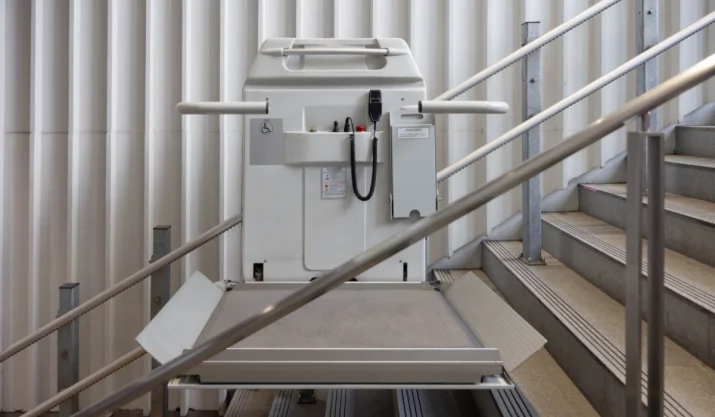
Table of Contents
- How a Platform Stair Lift for Home Use Works
- How Platform Stair Lifts Compare With Other Home Lifts
- Which Staircases Can Accommodate a Platform Stair Lift?
- Safety Features and New Installation Requirements
- How to Decide Whether a Platform Stair Lift Fits Your Home and Routine
- Choosing a Platform Stair Lift for Your California Home
- Frequently Asked Questions
A platform stair lift for home use carries you and a compatible wheelchair or mobility scooter along the staircase without requiring you to transfer into a separate seat. You roll onto the platform, travel between floors, and stay in the mobility device you already use.
That makes it different from a seated stair lift, and it also works differently from a vertical platform lift. Whether one will fit your home depends on the staircase, landing space, rail path, wheelchair or scooter dimensions, and how other people use the stairs.
This guide explains how a platform stair lift works, which staircases can accommodate one, the space and safety features to look at, and what happens during a new installation. It also gives you practical questions to consider before deciding whether this type of lift fits your home and daily routine.
Key Takeaways
- A platform stair lift carries a wheelchair or compatible mobility scooter along the staircase, so you don’t need to transfer to a lift chair.
- Stair width is only part of the fit. Landings, doors, turns, rail placement, headroom, and the size of the mobility device also affect the installation.
- A new lift should be selected after the staircase and mobility device are measured together because platform size, rated load, rail design, and safety features vary by system.
How a Platform Stair Lift for Home Use Works
A platform stair lift is also called an inclined platform lift or wheelchair platform lift. “Inclined” describes the direction of travel. The platform rides on a rail that follows the angle of the staircase instead of moving straight up and down.
You enter the platform at one landing while staying in your wheelchair or compatible scooter. The lift then carries you along the staircase to the other floor. The basic idea is closer to a small moving floor than a traditional stair-lift chair.
How the Platform and Rail Work
The rail determines the path the lift follows. On a straight staircase, the route is relatively simple. A curved staircase, bend, or intermediate landing requires a rail designed around that shape.
Some systems use a folding platform so the lift takes up less stairway space while parked. That can help when other household members still walk up and down the stairs. The open platform still needs enough room to travel safely when the lift is being used.
Platform dimensions and rated loads differ by model. A compact manual wheelchair may fit where a larger power wheelchair or mobility scooter will not. For that reason, the actual mobility device should be measured before a platform lift for stairs is selected.
How Platform Stair Lifts Compare With Other Home Lifts
A platform stair lift, seated stair lift, and vertical platform lift can all help someone move between levels, but they solve different access problems. The simplest way to compare them is to look at what carries you and which direction the equipment travels.
| Feature | Platform Stair Lift | Seated Stair Lift | Vertical Platform Lift |
| Travel path | Along the staircase | Along the staircase | Vertically between levels |
| Stay in wheelchair or compatible scooter | Yes | No | Yes |
| Transfer to a lift seat | No | Yes | No |
| Uses the stair route | Yes | Yes | Usually uses a separate vertical path |
| Main space concern | Platform, rail, and landing clearance | Chair and footrest clearance | Vertical lift area and landings |
| Main question to ask | Can my device and staircase work together? | Can I transfer comfortably at both floors? | Is there a practical vertical route? |
Seated Stair Lifts
A seated stair lift carries you in a chair attached to a rail. If you can transfer into the chair comfortably at both ends of the staircase, it may be a practical way to move between floors while using less stairway space than a wheelchair-size platform.
For a full-time wheelchair user, the transfer can be the bigger issue. You may need another wheelchair upstairs, help from another person, or enough strength and balance to move between the wheelchair and lift chair each time you use the stairs.
Vertical Platform Lifts
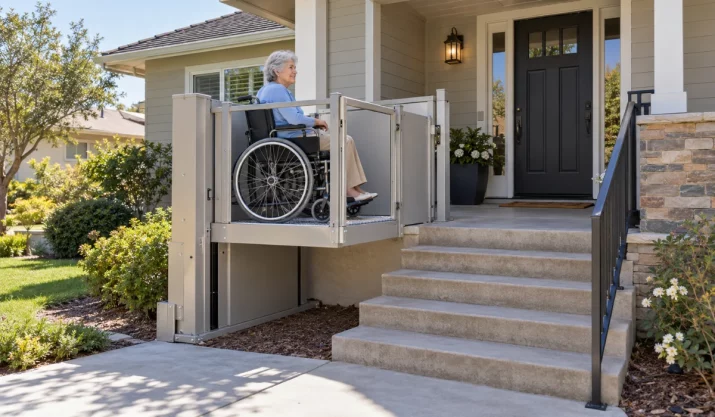
A vertical platform lift, sometimes called a VPL, also lets you stay in a compatible wheelchair or scooter. The difference is the travel path. Instead of following the stairs, the platform moves vertically between two levels.
That arrangement may work near a porch, garage entry, raised landing, or another part of the home where a vertical route is available. It doesn’t automatically replace an inclined platform lift. The home’s layout determines which option makes better use of the available space.
Which Staircases Can Accommodate a Platform Stair Lift?
A platform stair lift for home use needs enough room for the rail, platform, rider, and mobility device. A staircase can seem wide until you account for handrails, trim, newel posts, doors, and other features that reduce the usable space.
Straight staircases are generally easier to assess because the lift follows one continuous direction. Curved staircases and stairs with turns or intermediate landings require more detailed measurements. Whether they can support a wheelchair lift for stairs depends on the exact geometry and the equipment available for that route.
Stair Width and Rail Placement
Wall-to-wall width is only a starting point. The installer needs the usable width after accounting for anything that projects into the stairway.
Rail placement also affects how much space remains for people walking on the stairs. A folding platform can free up room while parked, but it doesn’t change the clearance required while the lift is open and moving.
Upper and Lower Landing Space
The landing needs enough room for you to approach the platform, line up the wheelchair or scooter, board, exit, and turn away. A nearby doorway may affect the layout if its swing crosses the boarding area.
| Area to Check | Why It Matters |
| Stair width | Determines whether the rail and open platform have enough clearance |
| Lower landing | Needs room for approach and boarding |
| Upper landing | Needs room to exit and move away |
| Door locations | Door swings can interfere with boarding or travel |
| Turns and intermediate landings | Affect rail design |
| Wheelchair or scooter dimensions | Must fit the selected platform |
| Rider plus mobility device weight | Must remain within the lift’s rated load |
| Headroom | Must remain clear through the full travel path |
Photos can help start the conversation, but they can’t replace measurements. A site assessment gives the installer the information needed to see whether the staircase, landings, and mobility device can work together.
Safety Features and New Installation Requirements
A wheelchair platform lift needs safety systems for boarding, travel, stopping, and exit. The exact equipment differs by manufacturer and model, so specific features should be confirmed on the system being considered rather than assumed to be standard on every lift.
The ASME A18.1 Safety Standard for Platform Lifts and Stairway Chairlifts covers this equipment category. The requirements that apply to a particular California installation can depend on the lift, property, adopted code edition, and local jurisdiction.
Safety Features You May See
| Feature | What It Does |
| Platform barriers or access ramps | Help control access to the platform during travel |
| Obstruction sensors | Stop or interrupt movement when the lift meets an obstruction |
| Constant-pressure controls | Keep the lift moving while the control is held on systems that use this design |
| Emergency stop | Gives the rider a direct way to stop the lift |
| Nonslip platform surface | Provides a more secure surface for wheelchair tires and feet |
| Call/send controls | Allow the lift to be called or moved from a landing |
| Backup power on equipped systems | Supports operation during certain power interruptions |
Safety also depends on how the equipment fits the space. A platform may be large enough for a wheelchair but still be awkward to board if the landing is tight or the approach angle is poor.
Site Assessment and Equipment Selection
A new installation begins with measurements of both the home and the mobility device. The installer needs the staircase dimensions, wheelchair or scooter size, rider weight, approach direction, landing layout, and information about normal traffic on the stairs.
Those measurements help determine the platform size, rail configuration, parking position, controls, and electrical requirements. If the staircase turns, the installer also has to plan how the rail will follow that change in direction.
The assessment should cover nearby doors, hallways, walls, handrails, and other features that could interfere with boarding or exiting. If more than one wheelchair or scooter will use the lift, both devices should be included in the planning.
Professional Installation and Handover
After professional installation, the lift should be tested through its full travel path. The installer can check stops, controls, sensors, platform components, barriers, and other features included with the selected system.
You should also be shown how to board, position the wheelchair or scooter, operate the controls, exit at both landings, and respond if the lift stops. Local permit, inspection, and code requirements should be handled for the specific property and equipment rather than assumed from another installation.
How to Decide Whether a Platform Stair Lift Fits Your Home and Routine
Start with the transfer question. If moving from your wheelchair or scooter into a stair-lift seat requires help, feels difficult, or leaves you without your usual mobility device on the other floor, an inclined platform lift addresses that problem directly.
Then look at the route. You need enough stair and landing space for the platform to open, travel, and allow comfortable entry and exit. A narrow staircase may be better suited to a seated stair lift if transfers are manageable. A home with enough room for a separate vertical path may be better suited to a vertical platform lift.
Think About Daily Use, Not Just the Staircase
Your mobility device is part of the decision. Platform size and rated capacity have to match the wheelchair or scooter you use regularly. A wheelchair lift for home use should therefore be selected from actual measurements rather than a product photo or a rough stair count.
It also helps to think about how long you expect to use the home. In its Home and Community Preferences Survey, AARP found that 77% of adults age 50 and older wanted to remain in their homes for the long term. If staying in the home is part of your plan, access to an upper floor may affect how much of the house you can continue using.
Consider Stair Use and Fall Risk Separately
A platform lift shouldn’t be described as a way to eliminate every fall risk in a home. It changes one specific part of the routine by giving a wheelchair or scooter user another way to move between floors.
That distinction matters because falls are common among older adults. The Centers for Disease Control and Prevention (CDC) reports that millions of adults age 65 and older report falling each year, or about one in four older adults. If stairs have become difficult to manage, reducing repeated stair use may be one part of a broader home-access plan.
Choosing a Platform Stair Lift for Your California Home
A platform stair lift for home use can be a good match when you want to travel between floors without leaving your wheelchair or compatible scooter. The right system depends on the actual staircase, rail path, landing space, door locations, mobility device dimensions, and rated load rather than the number of steps alone.
California Mobility evaluates those details before recommending a new lift. That lets you compare an inclined platform lift with a seated stair lift, vertical platform lift, or another home-access option based on the way you move through the house and the space available for installation.
If you’re planning a new installation, contact California Mobility to schedule an in-home assessment. Measurements from the visit can help determine which configuration fits the staircase and mobility device before equipment is ordered.