


Patient Lifts Explained for Families New to Home Caregiving
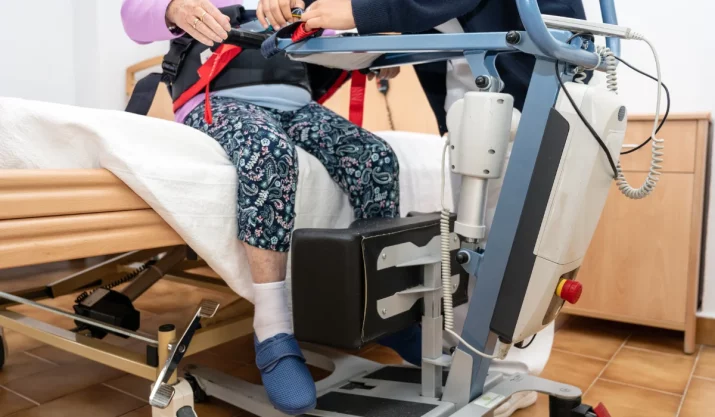
Table of Contents
- How Patient Lifts Help With Home Transfers
- Types of Patient Lifts for Home Use
- How Patient Lifts Support Safety and Dignity
- Choosing a Patient Lift Sling and Preparing the Room
- Training for Safer Patient Transfers at Home
- Making Home Caregiving More Sustainable With Patient Lifts
- Patient Lifts: FAQs
The first difficult transfer often changes how a family thinks about home care. Helping someone move from a bed to a wheelchair may mean supporting much of their weight while watching their feet, protecting a sore shoulder, steering around furniture, and trying to keep your own balance.
Patient lifts give you mechanical support for those everyday moves. Depending on the model, patient lifts can support most or all of a person’s body weight or assist with the move from sitting to standing. Families may use them for transfers between a bed, wheelchair, toilet, recliner, or another nearby surface.
For someone new to home caregiving, a lift can look more complicated than it is. The practical questions are simpler: Which type fits your loved one’s abilities? Will it work in the room? Which sling should you use? And what training do you need before the first regular transfer?
Key Takeaways
- Patient lifts reduce how much body weight a caregiver has to handle manually during many transfers.
- Manual hydraulic, electric, sit-to-stand, and ceiling track lifts serve different mobility needs and home layouts.
- Safe use depends on the complete setup, including the lift, sling, room arrangement, caregiver training, and the person’s current abilities.
How Patient Lifts Help With Home Transfers
A home patient lift takes part of the physical load out of a patient transfer. Instead of holding another adult’s weight through the entire movement, you position the equipment, secure the patient lift sling when one is required, operate the lift, and guide the person toward the destination surface.
The physical demands of patient handling are well documented in healthcare settings. According to OSHA’s safe patient handling guidance, nursing aides, orderlies, and attendants experienced 166.3 musculoskeletal disorder cases per 10,000 workers. Across all industries, the rate that year was 30.5 cases per 10,000 workers.
Those figures apply to paid healthcare workers, not relatives providing care at home. They still help explain why safe patient handling programs use mechanical transfer equipment instead of relying only on caregiver strength and lifting technique.
| Patient-Handling Finding | Published Figure | Practical Meaning |
| Musculoskeletal disorder rate among nursing aides, orderlies, and attendants | 166.3 cases per 10,000 workers | Patient-handling work can place substantial physical demands on caregivers |
| Musculoskeletal disorder rate across all industries | 30.5 cases per 10,000 workers | The reported rate was much lower across the broader workforce |
| Recommended maximum for manual patient lifting under ideal conditions | 35 pounds | Even supporting part of an adult’s weight can exceed recommended manual lifting limits |
The 35-pound figure comes from a peer-reviewed analysis on manual patient lifting. The paper concluded that 35 pounds should be considered the maximum recommended weight for manual patient-lifting tasks under ideal conditions. A transfer at home may involve tight angles, fatigue, uneven participation, or a sudden shift in balance.
Types of Patient Lifts for Home Use
Choosing among patient lifts for home use starts with what your loved one can safely do. Someone who can bear some weight and follow instructions may have different needs from a person who requires full-body support.
| Lift Type | How It Works | Situation It May Suit | Main Home Consideration |
| Manual hydraulic lift | A hand-operated hydraulic pump raises and lowers a sling | Full-body transfers when substantial support is needed | Requires room to position and turn the base |
| Electric patient lift | A battery-powered motor raises and lowers the sling | Frequent full-body transfers or when manual pumping is difficult | Needs charging access and floor clearance |
| Sit-to-stand lift | Assists a person moving from sitting toward supported standing | The person can participate and bear some weight | Requires suitable strength, control, and positioning |
| Ceiling track lift | An overhead motor moves along a fixed rail | Frequent transfers or rooms where a floor base is cumbersome | Requires installation planning and a defined transfer route |
Manual Hydraulic Patient Lifts
A manual hydraulic patient lift typically uses a wheeled base, upright mast, lifting arm, and sling. After you position and attach the sling, a hand-operated hydraulic pump raises the person for a bed-to-wheelchair transfer or another full-body move.
These lifts don’t need battery power for the lifting motion. They do, however, need enough floor area to approach the starting surface, clear furniture, and position the person correctly at the destination.
Electric Patient Lifts
An electric patient lift performs a similar transfer with a battery-powered lifting mechanism. Powered raising and lowering can reduce the repeated pumping required with a hydraulic model, which may be helpful when several transfers happen each day.
The caregiver still controls the setup. Sling position, floor clearance, wheelchair placement, and the person’s final position all need attention. Families should also learn the charging routine and emergency lowering procedure for the specific model.
Sit-to-Stand Lifts
A sit-to-stand lift assists someone who can take an active role in the transfer. It helps move the person from sitting toward supported standing rather than carrying them through the entire transfer in a full-body sling.
The person may need enough leg strength to bear some weight, enough trunk control to remain positioned, and enough understanding to follow instructions. If those abilities decline, a full-body patient transfer lift may become more appropriate after reassessment.
Ceiling Track Lifts
A ceiling track lift keeps the lifting motor overhead instead of using a large mobile floor base. The motor moves along a fixed rail while the sling supports the person below.
This design may suit a bedroom where a floor lift can’t easily fit around the bed or a home where the same transfer route is used several times a day. Installation planning should account for the structure, track route, starting point, and destination.
How Patient Lifts Support Safety and Dignity
A safe patient transfer should also feel respectful. Tell your loved one what is about to happen before moving the lift. Give them time to respond, keep clothing arranged appropriately, and let them handle any part of the transfer they can still perform safely.
Those small choices help preserve control at a time when someone may already feel dependent on others. A person who can place an arm, adjust a leg, or follow a positioning cue remains involved rather than simply being moved from one place to another.
Patient lifts also change what the caregiver has to do physically. You can concentrate on alignment, equipment movement, and comfort instead of supporting most of another person’s weight at the same time. Reducing manual lifting can lower exposure to the forces associated with caregiver strain, although good equipment still requires correct use.
A damaged sling, incorrect attachment, blocked path, poorly positioned wheelchair, or lift that doesn’t match the person’s abilities can create problems. Safe patient handling at home depends on the whole transfer, not just the lifting mechanism.
Choosing a Patient Lift Sling and Preparing the Room
A lift can be appropriate for the person and still be difficult to use if the sling or room setup is wrong. These details are worth working out before the equipment becomes part of the daily routine.
Match the Sling to the Person and Transfer
The patient lift sling directly supports the person’s body on a full-body lift. Slings come in different sizes and support configurations. Some provide more support around the head and trunk, while others are designed around specific transfer or toileting needs.
The Food and Drug Administration (FDA) advises caregivers to follow manufacturer instructions and make sure the sling is appropriate for the lift and patient. Check the required attachment points, weight rating, fabric, stitching, loops, and straps according to those instructions.
A sling shouldn’t be substituted simply because another model looks similar. Compatibility, fit, and body support all affect how the person sits or lies during the transfer.
Walk Through the Transfer Route
Room layout can rule out an otherwise suitable home patient lift. A floor lift may have adequate lifting capacity but still be awkward to use if the base can’t slide beneath the bed or turn between furniture.
Check the entire route. Look at bed clearance, wheelchair placement, doorways, bathroom fixtures, rugs, thresholds, and the space needed to turn the equipment. Bathrooms often need extra attention because several fixed objects occupy a small area.
There’s no single room dimension that works for every patient lift. Measure the equipment and the spaces where transfers will actually take place rather than relying on a general estimate.
Training for Safer Patient Transfers at Home
Hands-on caregiver training should cover more than the controls. Before regular use, you should know how to position the sling, identify attachment points, operate the lift, move the base when applicable, and place your loved one correctly on the destination surface.
Learn the less obvious procedures too. That includes the lift’s stated weight capacity, charging process for an electric model, inspection steps, and emergency lowering feature. A practice session gives you a chance to notice clearance or positioning problems before a real transfer is underway.
Transfer needs can change over time. Someone who uses a sit-to-stand lift now may lose strength after an illness or become less able to follow instructions. Changes in pain, balance, cognition, or weight-bearing ability may also affect the transfer method.
When there’s a meaningful change in function, have the setup reassessed by the appropriate healthcare or mobility professional. Adjusting a transfer by guesswork can create unnecessary risk for both the person receiving care and the caregiver.
Making Home Caregiving More Sustainable With Patient Lifts
Transfers are rarely a once-a-day task. A routine may include moving from bed to a wheelchair in the morning, using the bathroom, transferring into a favorite chair, and returning to bed later. When every patient transfer depends heavily on a family member’s strength, the physical workload builds quickly.
A well-matched patient lift puts more of that work onto equipment designed to support the person’s weight. The right setup considers the person’s functional ability, the type of transfer, the sling, room layout, and caregiver training. When those pieces fit together, the lift becomes a practical part of home caregiving rather than an intimidating medical device.
California Mobility offers accessibility solutions that reflect a practical approach, where equipment needs to fit both the person and the house. If transfers are becoming harder or you’re planning for longer-term care at home, contact California Mobility to discuss accessibility solutions that fit your space, routines, and mobility needs.