

The Upright Walker Promise of Better Posture Put to the Test
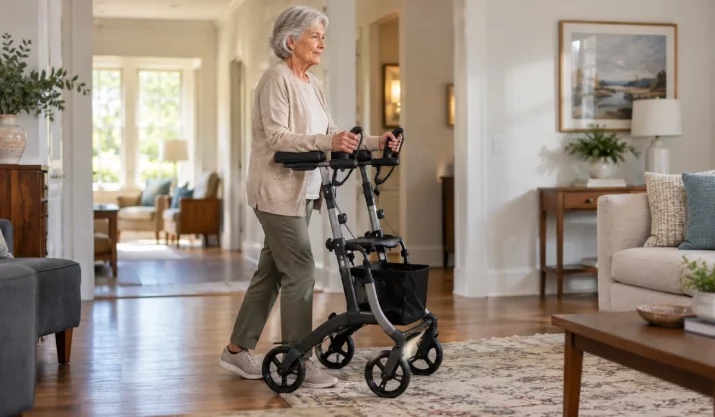
Table of Contents
- Does an Upright Walker Actually Improve Posture?
- How Forearm Supports and Taller Handles Change Body Mechanics
- Who May Benefit From an Upright Walker and Who May Not?
- How to Test an Upright Walker Before You Choose One
- Choosing the Right Upright Walker for Daily Mobility
- Frequently Asked Questions About Upright Walkers
An upright walker makes a simple promise: stand taller and walk with less hunching. Higher handles and padded forearm supports bring the contact point closer to your upper body, so you don’t have to reach down as far as you would with many standard walkers.
That change can affect walking posture and comfort. It doesn’t mean the walker fixes poor posture, treats back pain, or works better for every person. Your gait, balance, arm strength, walker height, and home layout all shape the result.
If you’re comparing an upright walker for yourself or a family member, the most useful question isn’t whether it makes you look straighter. The real test is whether you can walk, turn, brake, sit, and move through your usual spaces without strain or loss of control.
Key Takeaways
- An upright walker may reduce forward leaning by raising the support point, but it doesn’t correct every cause of poor posture.
- Forearm supports change how your upper body carries weight, which can reduce pressure on the hands but may increase demand on the arms and shoulders.
- Proper walker fit, brake control, maneuverability, and a real-world trial matter more than the word “upright” on the product label.
Does an Upright Walker Actually Improve Posture?
An upright walker can reduce the amount of downward reaching required during walking. If low handles make you bend at the waist or push a walker far in front of you, a taller support position may help you stay closer to vertical.
That’s a change in walking position, not a permanent correction to posture. Forward leaning can come from arthritis, fatigue, muscle weakness, balance problems, joint restrictions, or changes in the spine. Raising the handles can’t remove those causes.
A useful way to judge the effect is to compare how you stand with and without the walker. If your posture changes mainly when you reach for the device, walker adjustment may be part of the problem. If you remain bent forward without it, changing walker height alone is less likely to make a large difference.
The Centers for Disease Control and Prevention (CDC) reports that more than 14 million adults age 65 and older fall each year, which is about one in four older adults. That number doesn’t prove that one walker design is safer than another. It does show why stability, control, and proper fit deserve as much attention as posture.
How Forearm Supports and Taller Handles Change Body Mechanics
A standard walker or rollator walker usually places most upper-body support through the hands. A forearm support walker raises that contact point and gives you a larger surface to lean against.
That shift changes the position of your elbows, shoulders, and trunk. It can also change how much weight you place through your upper body while walking.
How Forearm Supports Redistribute Pressure
Forearm supports spread contact across more of the arm than a handgrip alone. If pressure through your wrists or hands becomes uncomfortable, that wider support area may feel better.
A Clinical Interventions in Aging study of a four-wheeled walker with armrests found that changing armrest height affected both forearm loading and the amount of load carried through the feet. That finding matters when you adjust an upright walker because even a small height change can alter how your body shares the load.
The position still has to feel natural. Supports that sit too high can make you lift your shoulders. Supports that sit too low may leave you bending forward, which defeats the main reason many people consider this type of mobility aid.
Why Taller Handles Can Reduce Forward Leaning
Taller handles can reduce the distance you need to reach toward the walker. That can help if low grips contribute to a forward-leaning posture or back strain.
The frame also needs to stay close to you. If you push the walker too far ahead, you may still lean forward even when the supports are high. Good walking posture depends on both the walker adjustment and where you position the frame.
Upright Walker vs. Standard Walker
A standard walker isn’t automatically bad for posture, and an upright model doesn’t guarantee better posture. Either one can work well when the dimensions and support position match the user.
| Feature | Upright Walker | Standard Walker or Rollator |
| Support position | Higher, often through forearms | Lower, mainly through hands |
| Trunk position | May reduce forward bending | Can remain upright with correct fit |
| Wrist pressure | Some load may shift to forearms | More support passes through hands |
| Shoulder demand | Depends strongly on support height | Depends on handle height and grip |
| Frame profile | Often taller and bulkier | Often more compact |
| Maneuverability | May need more turning room | Often easier in tighter spaces |
| Transport | Can take more storage space | Many models fold smaller |
| Best fit | Depends on gait, strength, and environment | Depends on gait, strength, and environment |
The comparison is less about which design is better and more about what each one asks your body to do.
Who May Benefit From an Upright Walker and Who May Not?
Some people notice a clear difference when they move from lower handgrips to forearm support. Others find the larger frame tiring or awkward. The design makes the most sense when it solves a specific problem.
When an Upright Walker May Help
If you continue to hunch over a traditional walker after the handles have been adjusted correctly, a higher support point may reduce the amount of bending needed. That can be useful when forward reaching contributes to back strain or shoulder tension.
Forearm supports may also help if prolonged pressure through standard walker handles becomes uncomfortable. They spread contact across a larger area, although they don’t guarantee relief from wrist, shoulder, or back pain.
Some users also prefer the higher line of sight. Looking forward can feel more natural during conversation or while walking through a home, provided you can still steer and brake with control.
When Another Walker May Work Better
Limited arm strength can make an upright walker harder to manage. You still need enough strength and coordination to guide the frame, operate the brakes, and keep it from rolling too far ahead.
Tight spaces can be another drawback. Some upright walkers have taller posts or broader frames, which can make turns harder in a small bathroom, narrow hallway, or crowded bedroom. A compact rollator walker may offer better maneuverability in those settings.
A fixed forward posture also changes the decision. If your body can’t comfortably straighten because of a spinal or joint condition, forcing a taller position may create discomfort somewhere else. In that situation, stable movement matters more than appearing fully upright.
How to Test an Upright Walker Before You Choose One
Proper walker fit is easier to judge when you test more than straight-line walking. A short showroom lap may feel fine even when the walker becomes uncomfortable after several minutes.
Start with the support height, then check what happens as you move.
| What to Test | What to Look For |
| Standing position | Your trunk feels natural rather than forced |
| Shoulder position | Shoulders stay relaxed |
| Forearm contact | Pads support you without pressure points |
| Walker distance | Frame stays close enough that you don’t reach |
| Braking | You can stop without changing your grip |
| Straight walking | Walker doesn’t pull ahead |
| Turning | You can turn both directions with control |
| Sitting | You can approach a chair and sit safely |
| Flooring changes | You can manage carpet, hard floors, and thresholds |
| Longer walking | Your arms, wrists, shoulders, and back remain comfortable |
| Storage | Walker fits where you plan to keep it |
| Transport | Folded walker fits your vehicle |
Check Walker Height and Arm Position
Traditional walker guidance offers a useful point of comparison. The American Academy of Family Physicians advises that standard walker hand grips generally align with the wrist crease when you stand with your arms relaxed, with a slight bend at the elbows when you grip the handles.
An upright walker uses a different support position, so follow the adjustment range for that model. Look for relaxed shoulders, comfortable elbow placement, and enough room to stand close to the frame without crowding it.
Adjust One Setting at a Time
If something feels wrong, change one setting and repeat the same walking test. Adjusting several parts at once makes it harder to tell what helped.
Shoulder tension can point to supports that are too high. Reaching forward may mean the walker is too far away, while heavy pressure through the forearms may mean you’re relying on the frame more than expected.
Try It in Real-Life Conditions
Measure doorways, bathroom entrances, hallway turns, and furniture gaps before choosing a walker for home use. A model that feels easy to control in an open showroom can be frustrating in a narrow space.
If you plan to use it outdoors, think about sidewalk joints, patios, driveway slopes, and changes in flooring. Longer trial use is also useful because fatigue can reveal problems that don’t show up during the first few minutes.
Choosing the Right Upright Walker for Daily Mobility
An upright walker can help some people walk with less forward bending because its higher handles and forearm supports change where the body receives support. That can make walking feel easier when lower grips contribute to hunching, hand pressure, or back strain. It isn’t a posture cure, and it may not suit someone with limited arm strength, difficulty braking, or very tight spaces at home.
The best choice comes down to fit and real use. Check the support height, walk long enough to notice fatigue, test the brakes, make tight turns, and confirm that the frame works in the rooms and vehicles that are part of your routine.
California Mobility helps seniors and families plan for safer movement at home, including the access barriers that can affect daily mobility. If you’re comparing mobility equipment or home accessibility options, contact California Mobility to discuss solutions that fit your home, routine, and long-term needs.