

What is normal stair lift noise in San Francisco homes?

Table of Contents
If you’ve been thinking about getting a stair lift, you’ve probably wondered how loud it will be. Stair lift noise levels are a common concern, especially in older San Francisco homes where walls are thin and the whole family is nearby. The good news is that modern stair lifts are much quieter than most people expect.
Key Takeaways
- Most stair lifts run at 40–50 decibels — about as loud as a quiet conversation or a refrigerator hum
- San Francisco’s older Victorian and Edwardian homes can affect how sound travels, but this rarely causes real problems
- A soft clicking or gentle hum during operation is completely normal
- Grinding, squealing, or sudden loud noises are signs to call for service
How loud is a stair lift, really?
The honest answer: not very loud at all. Most modern stair lifts produce around 40 to 50 decibels when running. That’s roughly the same sound level as a quiet room, a softly running refrigerator, or two people having a normal conversation across the table.
Compare that to a vacuum cleaner at 70 decibels, or a city bus rumbling past your window on Geary Boulevard, and a stair lift barely registers. Most people are genuinely surprised the first time they hear one run.
The motor hums, the chair glides along the rail, and that’s about it. You’ll hear it, but it’s not going to drown out the television or wake someone sleeping in the next room.
What sounds are completely normal?
It helps to know what to expect so you’re not worried about something that’s working just fine.
A steady hum or whir is the sound of the motor doing its job. It starts when the lift moves and fades when it stops. This is normal on every model.
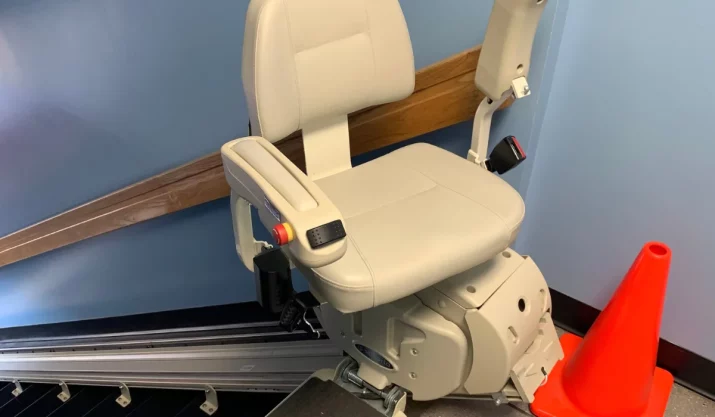
A soft click at the top or bottom is often the lift locking into the landing position. Some models make a small click when the footrest folds up or down as well. Both are nothing to worry about.
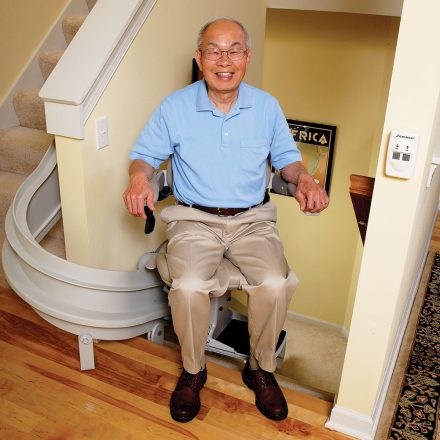
A slight mechanical sound on curves is common on stairlifts built for curved staircases. The rail bends to follow your stairs, and the drive system adjusts as it rounds each turn. You may hear just a bit more sound through those sections compared to a straight run.
If your stair lift sounds like this from day one and continues to sound the same over time, it’s working exactly as it should.
How San Francisco homes affect stair lift noise levels
San Francisco has a lot of character in its housing stock, and that character can affect how sound moves through a home. Victorian flats, Edwardian rowhouses, and 1920s-era two-story homes are built differently than modern construction. Hardwood floors, open stairwells, plaster walls, and high ceilings can all let sound carry further than you’d expect.
That said, a stair lift isn’t loud enough to create real noise problems even in these homes. What might happen is that the hum sounds slightly more noticeable in a home with hardwood floors and an open staircase than it would in a carpeted hallway. It’s not a problem — just something to be aware of.
San Francisco’s outdoor environment is another factor worth mentioning. If you have an outdoor stair lift on your front steps — which many homes in the Sunset, Noe Valley, or Glen Park have — the salty, foggy air can affect mechanical parts over time if the lift isn’t properly maintained. A well-maintained outdoor lift stays quiet. One that’s been neglected in the fog may start to sound different as parts wear.
For indoor use, explore the range of indoor stair lifts designed for the kind of narrow, steep staircases common in San Francisco homes.
When noise is a warning sign
There’s a difference between normal operating sounds and sounds that mean something needs attention. Here’s what to watch for:
Grinding or scraping is not normal. This can mean debris is caught in the rail, or that a part is worn and making contact where it shouldn’t be. Stop using the lift and call for service.
Squealing or high-pitched sounds often point to a lubrication issue. The rail and drive system need regular lubrication to stay quiet and work smoothly. This is one of the most common maintenance items and one of the easiest to fix.
Clicking that’s gotten louder or more frequent can mean a component is loose or worn. One soft click at the landing is normal. Repeated clicking throughout the ride is worth having a technician check.
Any change from baseline is worth paying attention to. If your lift has been quietly humming for two years and suddenly sounds different, trust that instinct. You know what your lift normally sounds like better than anyone.
Tips for keeping your stair lift quiet
Regular maintenance goes a long way. Most manufacturers recommend a service checkup once a year, and that schedule helps catch small issues before they turn into noisy ones.
Keep the rail clean. Dust, pet hair, and small debris can accumulate on the track and cause extra noise during operation. A soft cloth wipe-down every few weeks takes less than five minutes.
If you’re still in the shopping phase and quiet operation is a priority for you, ask your dealer to walk you through the specific models they carry. Some are measurably quieter than others, and a good dealer will give you a straight answer rather than just telling you what you want to hear.
If a stair lift isn’t the right fit for your home’s layout, it’s worth looking at alternatives like a vertical platform lift or a Home Lift.
Ready to find a quiet, reliable stair lift in San Francisco?
California Mobility has been helping California families find the right mobility equipment for their homes for years. We’re a family-owned company, and we’ll give you honest answers — not a sales pitch.
Request a free quote online or give us a call at (916) 560-0607. We’re happy to talk through your staircase, your home, and what’s going to work best for you.
Frequently Asked Questions
Will a stair lift be loud enough to disturb someone sleeping nearby? In most cases, no. At 40–50 decibels, a stair lift is quiet enough that it won’t travel far through walls or floors. In a San Francisco flat where bedrooms are close to the staircase, you might hear it faintly, but it’s not the kind of sound that wakes people up. If noise is a real concern for your home’s layout, mention that when you’re comparing models — some run quieter than others.
Does San Francisco’s fog and moisture make stair lifts noisier over time? Moisture and salt air can affect outdoor stair lift components if the lift isn’t maintained properly. For outdoor lifts especially, annual service and keeping the rail clean and lubricated helps prevent the kind of wear that leads to extra noise. Indoor stair lifts are largely unaffected by San Francisco’s climate since they’re protected from the elements.
Is it normal for a stair lift to make noise only on curved sections of the staircase? Yes, this is common. Curved stair lifts have a more complex rail system to follow the shape of your stairs, and the drive mechanism works a little harder through those turns. A slight increase in sound through curves is expected. If the noise is jarring, very loud, or getting worse over time, that’s worth having checked — but mild variation in sound is normal.
How do I know if the noise I’m hearing means something is wrong? Think of it this way: normal sounds stay consistent and are relatively quiet. Problem sounds tend to be new, louder than usual, or different in character — grinding, squealing, or repeated clicking mid-ride. If your stair lift sounds the same today as it did when it was installed, it’s almost certainly fine. If something sounds off compared to how it usually runs, call your dealer and describe what you’re hearing.