

Stair lift tips during stroke recovery in Sacramento homes
Table of Contents
Coming home after a stroke is a big moment — and for many Sacramento families, the first obstacle is literally the stairs. A stair lift for stroke recovery can make the difference between safely returning to your bedroom and bath upstairs versus being confined to one floor. Here’s what you need to know to make it work well.
Key Takeaways
- A stair lift gives stroke survivors a safe way to move between floors without relying on a caregiver for every trip
- Look for models with wide seats, padded armrests, and easy-to-use controls, especially if one side of the body is weaker
- Have a local technician assess your staircase before you buy — Sacramento homes vary widely from 1950s bungalows to newer two-story builds
- Start with supervised rides until your family member is confident using the lift on their own
Why stairs become a real problem after a stroke
A stroke can affect balance, muscle strength, and coordination — sometimes on just one side of the body. What used to be a quick trip upstairs can suddenly feel risky or even impossible without help.
Many Sacramento homes were built before single-floor living was a priority. Older neighborhoods like Curtis Park, Land Park, and East Sacramento are full of two-story homes where the bedrooms and bathrooms are upstairs. If your loved one can’t safely climb those stairs, you’re either looking at a major lifestyle change or a solution like a stair lift.
A stair lift doesn’t require your family member to have full strength or balance. They sit down at one level, ride to the other, and stand up when they’re ready. That alone removes one of the biggest daily hazards during recovery.
Choosing the right stair lift for stroke recovery
Not all stair lifts are built the same, and stroke survivors have some specific needs worth thinking through before you buy.
Look for simple, one-handed controls
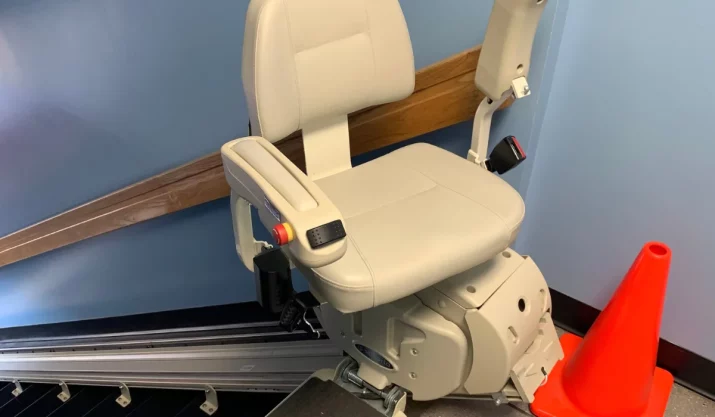
Many stroke survivors have weakness or limited movement on one side. A lift with a joystick or large paddle control that works with one hand is much easier to use than a model that requires two-handed operation. Ask the dealer to show you exactly how the controls work before committing.
Seat size and armrests matter
A wide, padded seat with sturdy armrests makes it much easier to sit down and stand up safely. Some models include a powered swivel seat that turns the chair toward the landing — that’s a helpful feature for someone with balance issues, since it means they don’t have to twist to get off.
Straight vs. curved staircase
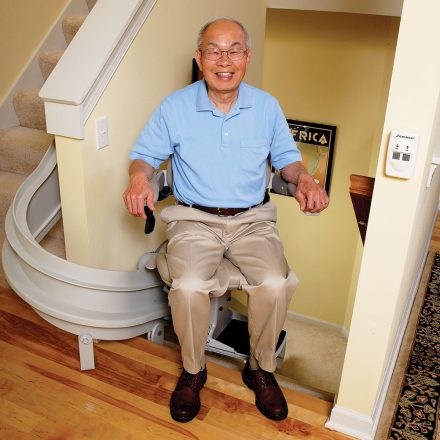
Most Sacramento homes have straight staircases, which are simpler and less expensive to fit. If your staircase turns or has a landing in the middle, you’ll need a curved rail — or possibly a vertical platform lift as an alternative. A local technician can walk your staircase and give you an honest assessment. You can browse indoor stairlift options to get a sense of what’s available.
Getting the installation right
Buying the right lift is only half the job. How it’s installed in your specific home matters just as much.
Have someone measure in person
Stair widths, ceiling heights, and landing space all affect which model fits and where the rail ends. If the lift drops off too close to a doorway or the footrest swings into a wall, it creates new hazards instead of solving old ones. A home visit from a trained installer removes that guesswork.
Clear the path at both ends
Make sure there’s a clear, stable place to stand at both the top and bottom of the stairs. Remove rugs that slide, and make sure any handrails along the wall are secure. The stair lift handles the riding part — you want the getting-on and getting-off spots to be as safe as possible.
Think about the outdoor steps too
Sacramento homes often have front or back steps that need to be managed as well. If your family member needs to get to medical appointments or wants to sit outside in the mild Sacramento weather, outdoor stairlifts can handle those exterior stairs. Weather here is generally forgiving compared to other parts of the country, but you still want a model rated for outdoor use.
Helping your loved one use the lift with confidence
The lift itself is only useful if the person feels comfortable using it.
Practice together first
Sit with your family member for the first several rides. Point out how to start and stop the lift, where the safety sensors are, and what to do if it stops mid-stair (usually just releasing and re-pressing the control). Repetition builds comfort.
Don’t rush independence
It’s fine to ride with them for the first week or two, then gradually step back as they get more confident. Some families set a simple rule: the first solo ride happens when the occupational therapist or physical therapist says they’re ready.
Talk to the rehab team
Stroke recovery involves a team — doctors, physical therapists, occupational therapists. Let them know you’ve installed or are considering a stair lift. An occupational therapist in particular can offer advice on transfers, positioning, and whether any home modifications would make the lift easier to use.
When a stair lift isn’t the right fit
Sometimes a staircase is too narrow, too steep, or too unusual for a standard lift rail. In those cases, a vertical platform lift or a Home Lift may be a better option. These allow someone to remain in a wheelchair or walker rather than transferring to a seat, which matters for some stroke survivors.
If the main challenge is getting into or out of the home rather than between floors, ramps may be worth adding as well.
Ready to find the right setup for your home?
California Mobility is a family-owned company based right here in Sacramento. We’ve helped many local families figure out what works for their specific home and situation — no pressure, just honest advice.
Request a free quote at californiamobility.com/request-a-quote/ or call us at (916) 560-0607. We’ll come out, look at your stairs, and walk you through your options.
Frequently Asked Questions
Can a stroke survivor use a stair lift if they have weakness on one side? Yes — that’s actually one of the most common reasons families choose a stair lift. Look for a model with one-handed controls and a powered swivel seat to make transfers easier. A local installer can help you match the right features to your family member’s specific limitations.
How soon after a stroke can someone start using a stair lift? There’s no single answer because every recovery is different. Many families install the lift before their loved one comes home from rehab so it’s ready from day one. Check with the rehab team — they can tell you when the person is ready to transfer safely to a seated lift and ride independently.
What if my Sacramento home has a curved or unusual staircase? Curved staircases can be fitted with a custom-curved rail, though this costs more than a straight rail setup. In some cases — especially if the staircase is very narrow or steep — a vertical platform lift or Home Lift may be a better solution. The best way to know is to have someone come out and measure in person.
Is a stair lift a permanent change to the home? No. Stair lifts are mounted to the stairs themselves, not the walls, and can be removed without major damage to the home. Many families use them during a recovery period and then remove them, or keep them as a longer-term accessibility feature. If you’re renting, check with your landlord before installation.