

Stair lift tips for knee arthritis in San Diego homes

Table of Contents
- Why knee arthritis makes stairs so hard
- How knee arthritis changes what you need from a stair lift
- Indoor vs. outdoor stair lifts in San Diego
- What if stairs aren't the only challenge?
- Tips for using your stair lift comfortably with arthritic knees
- Ready to find the right fit for your San Diego home?
- Frequently Asked Questions
If knee arthritis is making the stairs in your San Diego home feel like a daily obstacle, a stair lift for knee arthritis can take a lot of the strain — and the worry — off your joints. The right lift, set up the right way, makes a real difference in how you move through your home each day.
Key Takeaways
- Knee arthritis affects how you sit, stand, and transfer, so the features you choose on a stair lift matter more than you might think.
- San Diego’s mix of single-story and multi-story homes — plus outdoor staircases common in hillside neighborhoods — means there are indoor and outdoor options worth considering.
- Seat height, armrest style, and swivel seat function all affect comfort for arthritic knees.
- A professional assessment of your staircase and your mobility needs will get you to the right solution faster than shopping online alone.
Why knee arthritis makes stairs so hard
Knee arthritis wears down the cartilage that cushions your knee joint. That means bending and straightening the knee — exactly what you do on every step — becomes painful and sometimes unstable.
Over time, many people start avoiding the stairs altogether. They sleep on the couch, skip the upstairs bathroom, or give up rooms they love. That’s not a good long-term plan for anyone’s health or quality of life.
A stair lift removes the bending and weight-bearing that hurts most. You sit down, ride up or down, and stand again at the top or bottom. Your knees do almost none of the work.
How knee arthritis changes what you need from a stair lift
Not every stair lift works the same way for every person. Knee arthritis specifically affects a few things that matter a lot when you’re choosing a lift.
Seat height
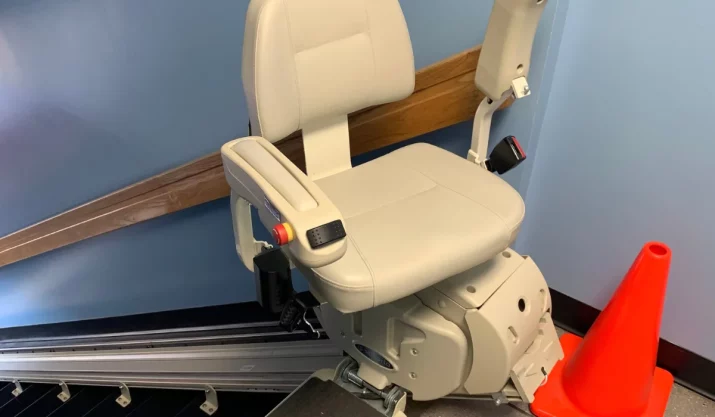
A seat that’s too low forces you to bend your knees deeply to sit down and push hard to stand back up — both painful moves when you have arthritis. Look for a lift with a seat that can be set at a comfortable height for your body. Many models offer adjustable seat heights or come in different configurations. When you have a consultation, make sure this gets measured properly for you.
Swivel seat
A swivel seat rotates at the top or bottom of the stairs so you can stand up facing away from the staircase. This matters a great deal for arthritic knees. Stepping off while twisted or facing down the stairs puts awkward stress on the joint. A powered swivel does this rotation for you with the press of a button, which is easier and safer than doing it yourself.
Armrests and footrest height
Good armrests let you push yourself up with your arms, taking pressure off your knees when you rise from the seat. The footrest should keep your feet supported and your knees at a comfortable angle throughout the ride — not hanging down or pressed up too high.
Easy-to-use controls
Swollen or stiff finger joints often come along with arthritis. A joystick or large paddle control is easier to use than a small button. Some models also come with a remote so a caregiver or family member can send the lift to the right floor.
Indoor vs. outdoor stair lifts in San Diego
San Diego’s geography means a lot of homes have stairs both inside and outside. Hillside neighborhoods like La Mesa, Point Loma, and parts of Mission Hills often have front or back exterior stairways leading up to the main entrance.
If your outdoor stairs are the barrier, an outdoor stairlift is built to handle sun, coastal salt air, and the occasional rain. San Diego’s mild climate is helpful — you won’t deal with freezing temps that affect lift mechanics — but UV exposure and moisture from marine layer are still real factors. Outdoor lifts are weatherproofed to handle all of it.
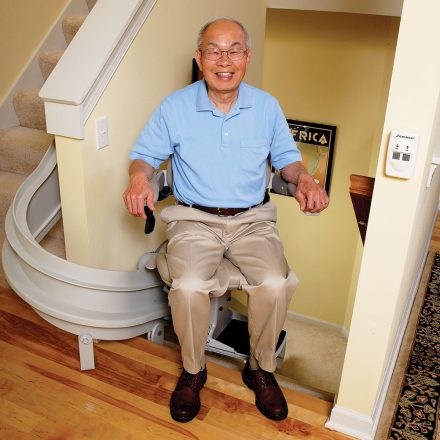
For stairs inside the home, an indoor stairlift is the go-to solution. These come in straight and curved rail configurations depending on the shape of your staircase. Many San Diego homes built in the 1960s through 1990s have straight staircases that are straightforward to fit.
What if stairs aren’t the only challenge?
For some people with knee arthritis, stairs are one of several mobility challenges in the home. If getting up from floor level is also difficult, a vertical platform lift might serve you better for certain transitions — like getting from a garage up to a main living level.
If your home has multiple floors and a more significant mobility limitation, a home lift or home lift gives you a fully enclosed ride between floors with no standing or stepping required.
And if you need to bridge a step or two at an entry, a ramp can be a simple, affordable fix that works well alongside a stair lift for a different part of the home.
Tips for using your stair lift comfortably with arthritic knees
Once your lift is installed, a few habits will make every ride more comfortable.
Take your time sitting down. Don’t rush the transfer onto the seat. Lower yourself slowly, using the armrests for support.
Let the swivel do its job. If your lift has a powered swivel seat, use it every time — even on days when your knees feel better. Consistency protects the joint.
Keep the footrest clean and adjusted. In San Diego, dust and occasional debris can collect on an outdoor lift’s footrest. A clean, properly adjusted footrest keeps your feet positioned correctly and reduces strain.
Tell your installer about your worst days, not your best ones. When you’re being fitted for your lift, describe what your knees feel like on a difficult pain day. That’s the benchmark your setup should be designed around.
Ready to find the right fit for your San Diego home?
California Mobility is a family-owned company that has helped people across California choose and install mobility equipment that fits their homes and their lives. If you’re dealing with knee arthritis and want honest advice about what will work best for your staircase, we’re glad to help.
Request a free quote online or call us at (916) 560-0607. We’ll talk through your home, your needs, and your options — no pressure, just practical answers.
Frequently Asked Questions
Can I use a stair lift if I can’t bend my knee very far? Yes, and limited knee bend is exactly why many people choose a stair lift. The seat and footrest can be adjusted so you don’t need to bend your knee past a comfortable angle to sit or stand. When you schedule a consultation, let the specialist know your range of motion so the setup accounts for it from the start.
Will a stair lift work on a curved staircase in my San Diego home? It can. Curved staircases require a custom rail that’s built to match the exact shape of your stairs. This takes a bit more time and costs more than a straight-rail installation, but it’s a well-established solution that works reliably. A home visit to measure your staircase is the first step.
Is a stair lift a permanent change to my home? No. Stair lifts are mounted to the stair treads, not the wall, so installation doesn’t require major construction. They can be removed if your needs change. This makes them a practical option if you’re unsure about a long-term commitment or if you’re helping a family member in a home that may eventually be sold.
How do I know if a stair lift or a home lift is better for my situation? A stair lift is usually the simpler, faster, and less expensive solution for one staircase. A home lift or home lift makes more sense if you have significant difficulty standing and stepping even briefly, if you use a wheelchair or scooter, or if you want to future-proof a home for more advanced mobility needs. A conversation with a mobility specialist — who can look at your home and your current abilities — will give you a clearer answer than any checklist.