

How call and send controls work on stair lifts in San Jose homes

Table of Contents
- What call and send controls actually do
- Where the controls are located
- How two people share one lift
- Call and send controls on outdoor stair lifts
- Safety features connected to the controls
- Straight vs. curved stairs — does it change how controls work?
- Ready to see how it works in your home?
- Frequently Asked Questions
If you share a staircase with a family member or caregiver, you’ve probably wondered what happens when the stair lift is parked on the wrong floor. That’s exactly what stair lift call and send controls are designed to solve. This guide explains how they work, why they matter, and what to look for when choosing a lift for your San Jose home.
Key Takeaways
- Call and send controls let you move the stair lift to whichever floor you need, even when you’re not seated on it.
- Most lifts include controls at both the top and bottom of the stairs, plus a handheld remote.
- These controls make a single lift usable by two people in the same household without constant coordination.
- Outdoor stair lifts in San Jose also use call and send controls and are built to hold up in the local climate.
What call and send controls actually do
A stair lift has one chair that travels up and down a rail. When two people in a household both use the lift, or when a caregiver needs to send it back after helping someone upstairs, the chair has to be movable without anyone sitting in it.
Call controls bring the lift to your floor. Send controls park it on the opposite floor after you’ve finished your ride. Together, they let one lift serve two people without anyone getting stuck waiting at the top or bottom of the stairs.
Think of it like calling an home lift. You press a button, the car comes to you, and when you exit, someone can send it back.
Where the controls are located
Most stair lifts come with controls in three places:
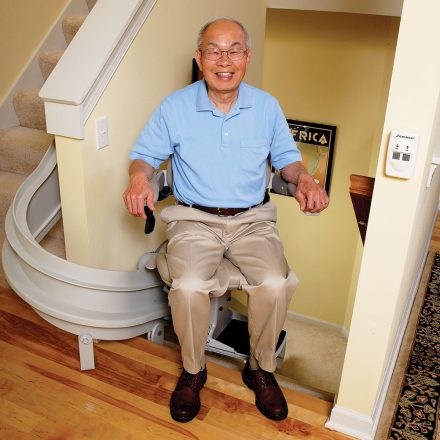
Wall switches at each landing. A small switch or button panel is mounted at the top and bottom of the stairs. Press the top switch and the lift travels up. Press the bottom switch and it travels down. These are sturdy and easy to use with arthritic hands.
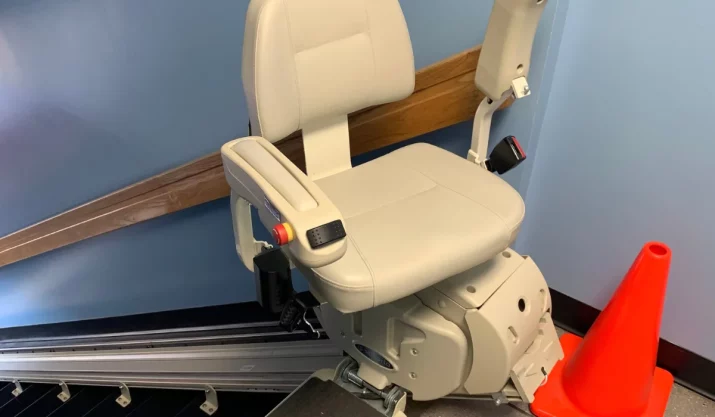
Joystick or button on the armrest. This is the main control you use while seated and riding. It’s usually a simple toggle or paddle — push one direction to go up, the other to go down. The lift stops the moment you release it, which is a basic but important safety feature.
Handheld remote. Many models include one or two small remotes, similar in size to a car key fob. These are handy if you want to send the lift upstairs before you start climbing, or if a caregiver needs to position the lift from across the room.
How two people share one lift
Here’s a common scenario in a San Jose household: an older parent lives upstairs and uses the lift each morning to come down for breakfast. Their adult child, who lives in the same home, sometimes needs the lift at the bottom of the stairs later in the day.
With call and send controls, this works smoothly. After the parent rides down, the adult child can press the upstairs wall switch to send the lift back up out of the way. Later, the parent presses the downstairs button to call it back. No one has to go up or down the stairs just to reposition the chair.
If you’re looking at indoor stairlifts, check whether the model includes remotes in the package or sells them separately. Some manufacturers include two remotes as standard; others charge extra.
Call and send controls on outdoor stair lifts
San Jose has a mild climate, but the summer heat and occasional winter rain still put outdoor equipment to the test. Outdoor stair lifts built for local conditions use the same call and send logic as indoor models, but the controls are weatherproofed.
If your home has exterior steps leading up to a deck, front door, or backyard, an outdoor stairlift gives you the same two-floor flexibility. The wall-mounted controls are sealed against moisture, and the remote fobs are designed to handle being left outside or stored near a door.
One practical tip: keep the remote inside your home, not mounted outdoors, so it stays out of direct sun and rain.
Safety features connected to the controls
The controls don’t work in isolation. They’re tied into the lift’s safety system. Most lifts will not respond to a call or send command if:
- The seat belt is not buckled (on some models)
- An obstruction sensor on the footrest or carriage is triggered
- The lift is already in motion
This means you can press the remote or wall switch without worrying that the lift will knock into something or someone on the stairs. The lift checks its own status before moving.
Some models also have a key switch, which lets you lock the controls entirely. This is useful in households with grandchildren who might play with the buttons.
Straight vs. curved stairs — does it change how controls work?
The controls work the same way whether your staircase is straight or curved. The main difference is the rail, not the controls. Curved staircases require a custom-built rail, which affects cost and lead time, but the call and send buttons behave identically once the lift is installed.
If you’re comparing options for a home with a curved staircase, the team at California Mobility can walk you through what’s available and what fits your specific layout.
Ready to see how it works in your home?
California Mobility is a family-owned company serving San Jose and communities throughout California. We install and service stairlifts, Home Lifts, vertical platform lifts, ramps, and more.
If you want to see how call and send controls feel in person — or just get a straight answer about what a stairlift would cost for your home — we’re glad to help.
Request a free quote online or call us at (916) 560-0607. We’ll come to your San Jose home, measure the stairs, and show you exactly how the controls work before you make any decisions.
Frequently Asked Questions
Can I add a remote to a stair lift that didn’t come with one? Some manufacturers sell remote controls as add-ons, and a technician can usually pair them to an existing lift. Compatibility depends on the brand and model, so it’s worth asking during installation or at your next service visit. California Mobility can check whether your current lift supports aftermarket remotes.
What happens if someone is on the stairs when I press the send button? The lift will travel down or up toward the person on the stairs and then stop when its obstruction sensor is triggered. For extra caution, most installers recommend making sure the staircase is clear before using call or send. The safety sensors are a backup, not a substitute for checking first.
Do call and send controls drain the battery? Moving an unoccupied chair does use battery power, but it’s minimal compared to carrying a rider. Most stair lift batteries are designed to handle many cycles per day, including repositioning trips. If your lift is older and the battery seems to drain quickly, it may be time for a battery check.
Are the wall-mounted controls hard to use if I have arthritis in my hands? Most wall switches are large rocker-style buttons or paddles that don’t require a strong grip or fine finger control. If standard controls are difficult, ask about models with larger buttons or touch-sensitive panels. When you schedule a consultation, mention any hand or grip limitations so the technician can show you the most accessible options available.