

How to sit safely on a stair lift in California homes

Table of Contents
Getting on and off a stair lift correctly makes a bigger difference than most people expect. Good stair lift weight distribution — how you position your body in the seat — reduces strain on the lift, protects your joints, and lowers your risk of losing your balance. Whether you live in a two-story craftsman in Sacramento or a hillside home in the Bay Area, these simple habits are worth building from day one.
Key Takeaways
- Sit all the way back in the seat before the lift moves — never perch on the edge
- Keep your feet flat on the footrest the entire ride, not dangling or resting on the stairs
- Use the armrests and seatbelt every single trip, even short ones
- Wait for the lift to stop completely before you stand up
Why sitting position matters on a stair lift
A stair lift is a mechanical system built to carry weight within a specific range and in a specific way. When that weight shifts forward, leans to one side, or presses unevenly, the motor works harder and the rail takes more stress than it should.
Over time, that extra stress adds up. It can shorten the life of the lift or trigger the safety sensors that stop the unit mid-stair — which is a lot less convenient than just sitting correctly in the first place.
Good posture on a stair lift also protects you. Many falls happen not during the ride but during the transfer — getting on or getting off. The way you sit sets you up for a safer dismount.
How to get on the stair lift correctly
Start at the bottom of the stairs
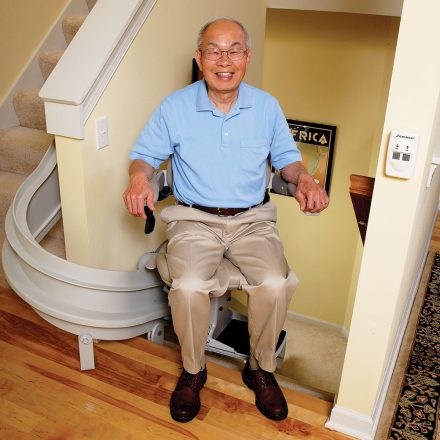
Park the lift at the bottom landing before you sit down. Turn around so your back faces the stairs, lower yourself into the seat the same way you would sit into a chair, and slide all the way back until your back touches the backrest.
Your feet should land flat on the footrest — not the floor, not the stair tread. If the footrest feels too high or too low, that is a fitting issue your installer can adjust. California Mobility sets up every indoor stairlift to match the rider’s height and mobility needs, so don’t hesitate to ask for a tweak.
Fasten the seatbelt before you start
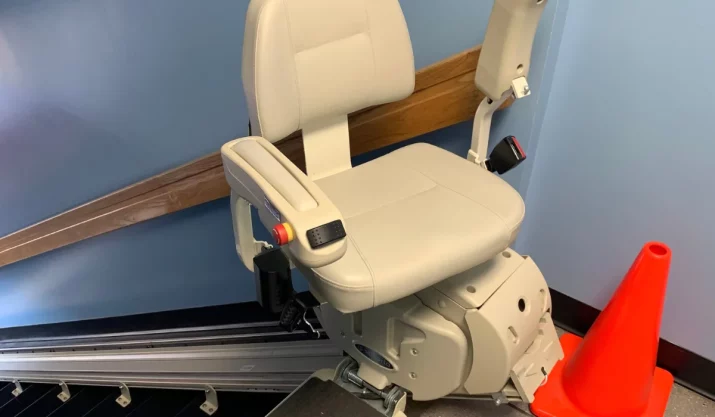
Every stair lift comes with a seatbelt or lap bar. Use it. This is not a suggestion for steep stairs only — it applies to a gentle four-step staircase just as much as a dramatic split-level in Marin County.
The belt keeps your body centered in the seat, which is exactly what good stair lift weight distribution depends on. It also catches you if the lift stops suddenly, which safety sensors can cause at any time.
Proper stair lift weight distribution during the ride
Keep your weight centered and even
Once you are seated and moving, resist the urge to lean forward to look down the stairs or twist sideways to check something. Shifting your weight to one side puts uneven pressure on the seat and rail.
Sit as you would in a dining chair: back straight, both feet on the footrest, hands resting on the armrests or in your lap. The ride only lasts a few seconds to a minute, so staying still is not a big ask.
Do not carry large loads on your lap
It is tempting to bring a laundry basket or a tray of dishes upstairs in one trip. Heavy or awkward loads change your center of gravity and can throw off your balance when you stand up at the top.
Use a small bag that hangs from the armrest, or better yet, make a second trip for items. Many California homes have tight stairways — older Victorians in San Francisco, narrow hallways in inland valley ranch homes — so keeping the ride simple and uncluttered is just practical.
Getting off safely at the top or bottom
This is where most incidents happen. The lift stops, the rider is eager to stand, and they push up before the unit has fully settled.
Wait for the lift to stop moving completely. Then plant both feet firmly on the floor — not the footrest, the actual landing — before you push up from the armrests. If you have grab bars or a handrail nearby, use them to steady yourself as you rise.
If standing up from the stair lift is consistently difficult, talk to your installer about swivel seat options. A swivel seat rotates to face the landing, so you are not twisting your body to stand. California Mobility’s indoor stairlift models include several options with powered swivel seats built for exactly this reason.
Special considerations for outdoor stair lifts in California
California’s climate varies a lot. Coastal areas can be damp and foggy. Inland areas hit triple-digit heat in summer. Both conditions affect how a stair lift performs and how you should approach getting on and off.
On cool, foggy mornings in areas like the Peninsula or the North Coast, outdoor seats can be damp. Sit down slowly and make sure your footing is solid before you start the lift. On hot days in the Central Valley or Southern California, metal parts of the footrest or armrests can be warm to the touch — simple awareness goes a long way.
Outdoor stairlifts are built for weather exposure, but the rider still needs to take the conditions into account when transferring on and off.
When to call your installer
If the lift stops mid-ride more than once, makes grinding or clicking sounds, or feels like it is jerking rather than moving smoothly, do not keep riding it. Those are signs the safety system is detecting a problem — possibly with weight distribution, possibly with the rail or motor.
A quick service call is far easier than dealing with an injury or a complete breakdown. California Mobility serves customers across the state and can usually diagnose common issues quickly.
Ready to find the right stair lift for your California home?
Whether you need an indoor model for a multi-level home or an outdoor stairlift for porch or garden steps, the team at California Mobility can walk you through your options with no pressure. We are a family-owned company, and we treat every customer the same way we would treat our own parents.
Request a free quote online or call us at (916) 560-0607 — we are happy to answer questions before you are ready to buy.
Frequently Asked Questions
How far back should I sit on a stair lift seat? You should sit all the way back so your lower back touches the backrest and your thighs are fully supported by the seat cushion. Sitting forward or on the edge shifts your weight toward the front of the seat, which stresses the lift mechanism and increases your risk of sliding forward during the ride. Think of it like sitting in a chair at a table — fully seated, not perched.
Can I put a bag or small item on my lap while riding? Light items like a small purse or a paperback book are generally fine. The issue arises with heavier or bulkier loads — laundry, grocery bags, or anything that makes it harder to sit centered and upright. Anything that changes how you shift your weight or makes it harder to stand up at the end of the ride is better left for a separate trip.
Why does my stair lift stop suddenly in the middle of the stairs? Most mid-ride stops are triggered by safety sensors. These sensors detect obstacles on the rail, unusual pressure from uneven weight distribution, or a mechanical issue in the motor. It does not always mean something is seriously wrong, but you should not ignore repeated stops. Contact your installer to have the unit checked — riding a lift that keeps stopping is both frustrating and potentially unsafe.
Is a swivel seat necessary, or is it just a nice extra? For many people, a swivel seat goes from a nice extra to a genuine need fairly quickly. If you have hip stiffness, knee pain, or balance concerns, twisting your body to stand up from a standard seat can be uncomfortable or risky. A powered swivel seat rotates you to face the landing before you stand, which makes the transfer much cleaner. It is worth discussing with your installer based on how you move day to day.